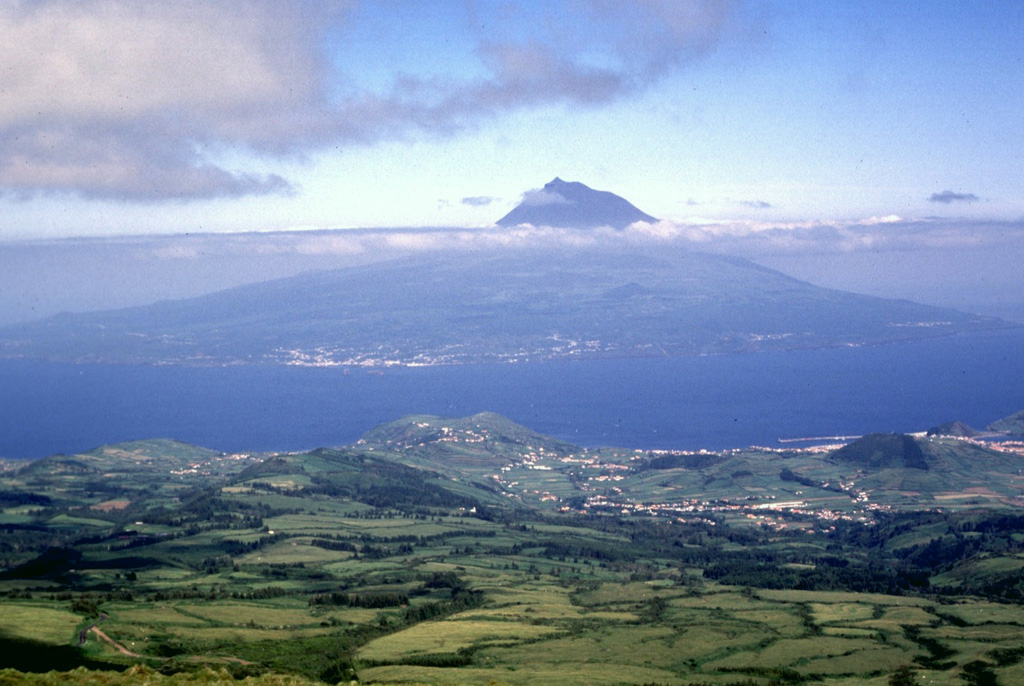
Volcano Mount Pico
Portugal's highest mountain rises 2,351 m straight out of the Atlantic on the Azores island named after it. Its last eruptions, in 1718 and 1720, sent lava down to the sea, and on those black lava fields islanders built the stone-walled vineyards that are now a UNESCO World Heritage Site.
Last eruption
Historical eruption
Summit
Stratovolcano · Basalt / Picro-Basalt
Activity
0 events (1.0x rate)
Interactive Volcano & Seismicity Map
Seismicity within 50 km radius, active VAAC ash plumes, and tectonic plate boundaries.
Recent seismicity within 50 km
60 events in the last 12 h within 25 km of the crater.
| Time | Magnitude | Epicenter / Place | Distance |
|---|---|---|---|
| 10d ago | M2.4 | 23 km E of Horta (Portugal) | 1.5 km |
| 1mo ago | M2.3 | Near Horta (Portugal) | 25 km |
| 1mo ago | M2.3 | 25 km W of Horta (Portugal) | 47 km |
| 1mo ago | M2.4 | 25 km NW of Horta (Portugal) | 47 km |
| 2mo ago | M2.2 | Near Horta (Portugal) | 31 km |
| 2mo ago | M2.0 | 26 km SE of Horta (Portugal) | 11 km |
Geological & Tectonic Profile
StratovolcanoMount Pico is an active Stratovolcano formed in an active Rift zone / Oceanic crust (< 15 km). Dominant lithology: Basalt / Picro-Basalt.
Volcano Dossier
VN #382020Official catalogue parameters, coordinates, elevation and geotectonic classification.
Authoritative Monitoring Infrastructure
Frequently Asked Questions (FAQ)
Verified scientific, operational, and emergency protocols
Catalogue: Smithsonian Institution, Global Volcanism Program.Smithsonian GVP profile